A Summer That Proved the Climate Crisis Is Here, Now, and Accelerating
This summer wasn’t just “another hot summer.” It was the hottest ever recorded in Western Europe — the average temperature for June and July reached 21.62°C, nearly three degrees above the norm, according to data from Europe’s Copernicus climate service. That broke the previous record set in 2022, and scientists warn the records are falling faster, not less often. For businesses, this makes Corporate Social Responsibility in 2026 more relevant than ever, as environmental responsibility and meaningful climate action become increasingly important parts of responsible business strategy.
The consequences aren’t measured in degrees alone. By early September, wildfires had scorched more than 647,000 hectares of land across the EU — nearly double the twenty-year average for this point in the season, according to the European Commission’s Joint Research Centre. France, Spain, Portugal and Greece all evacuated tens of thousands of people. The Loire, Po, Rhine and Danube rivers hit record-low water levels in August, placing additional strain on agriculture, transport and energy supply across the continent.
In the UK alone, the June heatwave is estimated to have cost the economy $1.55 billion and 24 million lost working hours — hitting the construction and agriculture sectors hardest, where people were effectively forced to work in temperatures the human body was never built to handle.
El Niño and the Winter Ahead: What the Forecasts Say
As we write this, meteorologists are tracking the development of a so-called “super” El Niño — one of the strongest ever recorded. NOAA’s Climate Prediction Center puts the odds above 90% that El Niño will reach “very strong” intensity through the fall and winter of 2026/2027, with a 69% chance it could break every record on the books. Sea surface temperatures in the central Pacific are already 1.8°C above average, and at depths of 50 to 150 metres, anomalies exceed 8°C — a heat reservoir scientists describe as exceptional fuel for the system.
What does that mean for us? Historically, strong El Niño events push precipitation patterns to extremes — dry regions get drier, and wet regions get hit with destructive rainfall in short bursts. Forecasters suggest winter could bring above-average snowfall to the Alps and Scandinavia, but they’re equally clear that the heightened flood risk should be taken seriously, not treated as a maybe. As Marty Ralph, director of the Center for Western Weather and Water Extremes at UC San Diego, put it to reporters: years like this rarely turn out mild — they tend to swing to one extreme or the other, either historically dry or historically wet.

Oceans, Food, and the Quiet Disaster Beneath the Surface
While wildfires and floods dominate the headlines, less is said about what’s happening beneath the surface of the sea. According to estimates from the Organisation for Economic Co-operation and Development (OECD), roughly 32 million metric tons of plastic accumulated in the ocean between 1950 and 2020 — equivalent to the weight of more than 200,000 whales. An additional 8 to 11 million tons of new plastic waste enters the ocean every year, and without serious global intervention, that figure could climb by another 61 million tons by 2060. It’s estimated that more than 100,000 marine mammals die every year because of plastic — through ingestion or entanglement.
This isn’t just an issue of polluted coastlines. Microplastics have entered the food chain — the fish we eat, the salt we use, the water we drink. At the same time, prolonged droughts are damaging crops across central Europe, Hungary and Romania, where vegetation indicators show serious deterioration due to lack of rainfall and repeated heatwaves. Put those two things together — polluted oceans and failing crops on land — and the conclusion is uncomfortable: food security is no longer an abstract concern for the future. It’s an issue being decided right now.
Who’s Responsible for All This? People — But Industry First
The science has been clear for decades: climate change is driven by human activity, and the largest share of that activity comes from the industrial sector — manufacturing, transport, agriculture and, yes, the plastics industry, which produces more than 430 million tons of plastic every year, of which less than 10% gets recycled. Every single day, the equivalent of 2,000 garbage trucks’ worth of plastic ends up in oceans, rivers and lakes worldwide.
This isn’t about assigning blame for blame’s sake. It’s a call for every company — large or small, global corporation or local business — to acknowledge its share of responsibility and, more importantly, take action that goes beyond marketing campaigns. The problem is that “social responsibility” too often gets reduced to a single social media post on Earth Day, while the operational chain — manufacturing, packaging, transport, the energy a company consumes — doesn’t change at all. That gap, between declared responsibility and actual responsibility, is what will determine whether a company is still operating in a way the planet can sustain ten years from now.
What Companies Can — and Must — Actually Change
Long-term goals sound abstract until they’re broken down into concrete, measurable steps. Here are a few areas where companies, regardless of size, have real power to make a difference:
– Packaging and materials — shifting from plastic to biodegradable, concentrated or reusable alternatives, even when it raises short-term production costs.
– Supply chains — choosing suppliers who can prove where raw materials come from and under what conditions they’re produced, instead of defaulting to the cheapest option with no questions asked.
– Energy and emissions — measuring and publicly reporting a company’s carbon footprint (including so-called Scope 1, 2 and 3 emissions), and shifting to renewable energy sources wherever feasible.
– Digitising operations — cutting paper use, printing and physical logistics by moving to online systems, which directly reduces the wood, water and energy needed to produce paper.
– Educating staff and customers — because no change in production actually works if the people using the product don’t understand or embrace it.
No single company is going to save the planet on its own, and it’s worth saying that plainly. But small changes, multiplied across thousands of companies that adopt them, stop being small. They become systemic change — and systemic change is the only thing capable of slowing the trends described earlier in this piece.
How Dazzle London Is Part of the Solution, Not the Problem
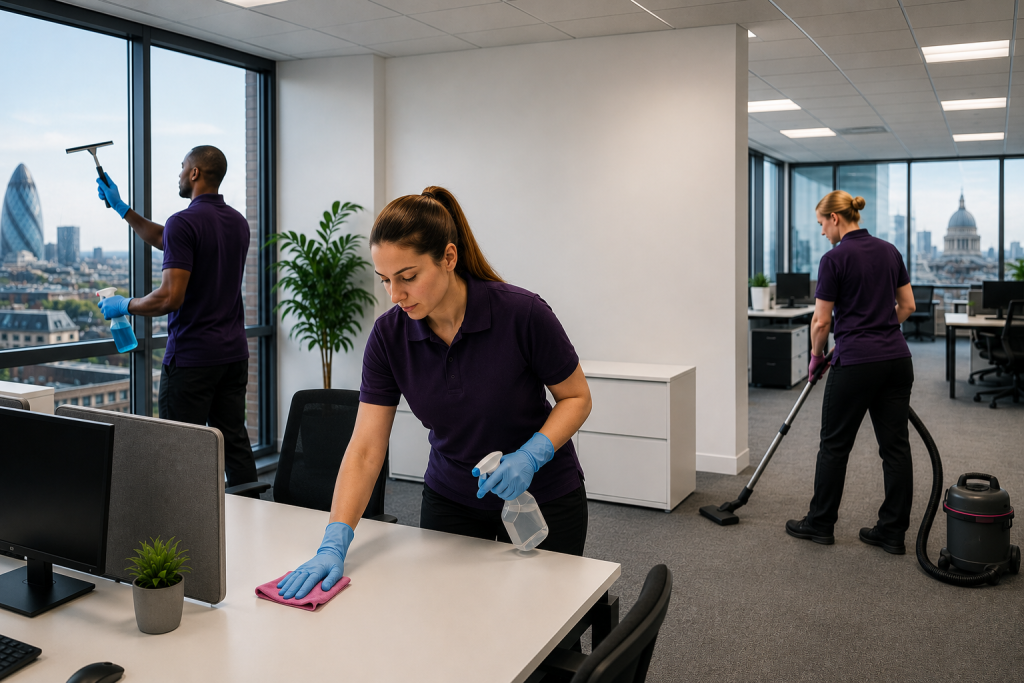
A few years ago, Dazzle Office Cleaning Company from London made the decision to change the way we operate — not cosmetically, but fundamentally, product by product, material by material. Today, there is exactly one place left in our operational chain where plastic is still used: buckets. Every other element has already moved to a non-plastic, biodegradable alternative. Most of our cleaning products now come as dissolvable sachets — concentrates that simply dissolve in water, with no plastic packaging left behind to end up in a landfill or, worse, a river or the sea. Our mop handles are wooden, not plastic, meaning that at the end of their life they break down naturally instead of sitting in the environment for centuries. The fact that only one single item across our entire range is still waiting for its non-plastic replacement says a lot about how deeply this change has actually been carried out — and how committed we are to closing that last gap too.
This shift doesn’t stop at the products we use in the field. Our back-office operations are fully eco-friendly — we don’t use paper, printing or physical documentation. Contracts, invoices, schedules and all internal communication run online, which means less wood, water and energy spent on producing and transporting paper, and zero physical waste from the administrative side of the business.
We know this isn’t enough, on its own, to stop the global crisis described in this article. But we believe this kind of approach — concrete, measurable, with no shortcuts on details as small as packaging, mop handles or paperwork — is what responsible business is supposed to look like in 2026.
The planet doesn’t need another company talking about sustainability. It needs thousands of companies willing to change even the smallest part of their production chain — because it’s exactly those small changes, multiplied enough times, that add up to a difference you can actually measure.